
URGENT: Bye, Copasa! Lavras Saneamento Consortium wins the bid and the new water and sewage company should start operating within 90 days
Consortium led by Sanea Ambiental wins unanimously, with R$ 121,9 milhões in concession fee and a tariff 7,5% below the current one, according to the City Hall. See Copasa's history in Lavras, complaints by neighborhood, and what changes for you
Automatically translated from Portuguese. Read the original in Portuguese
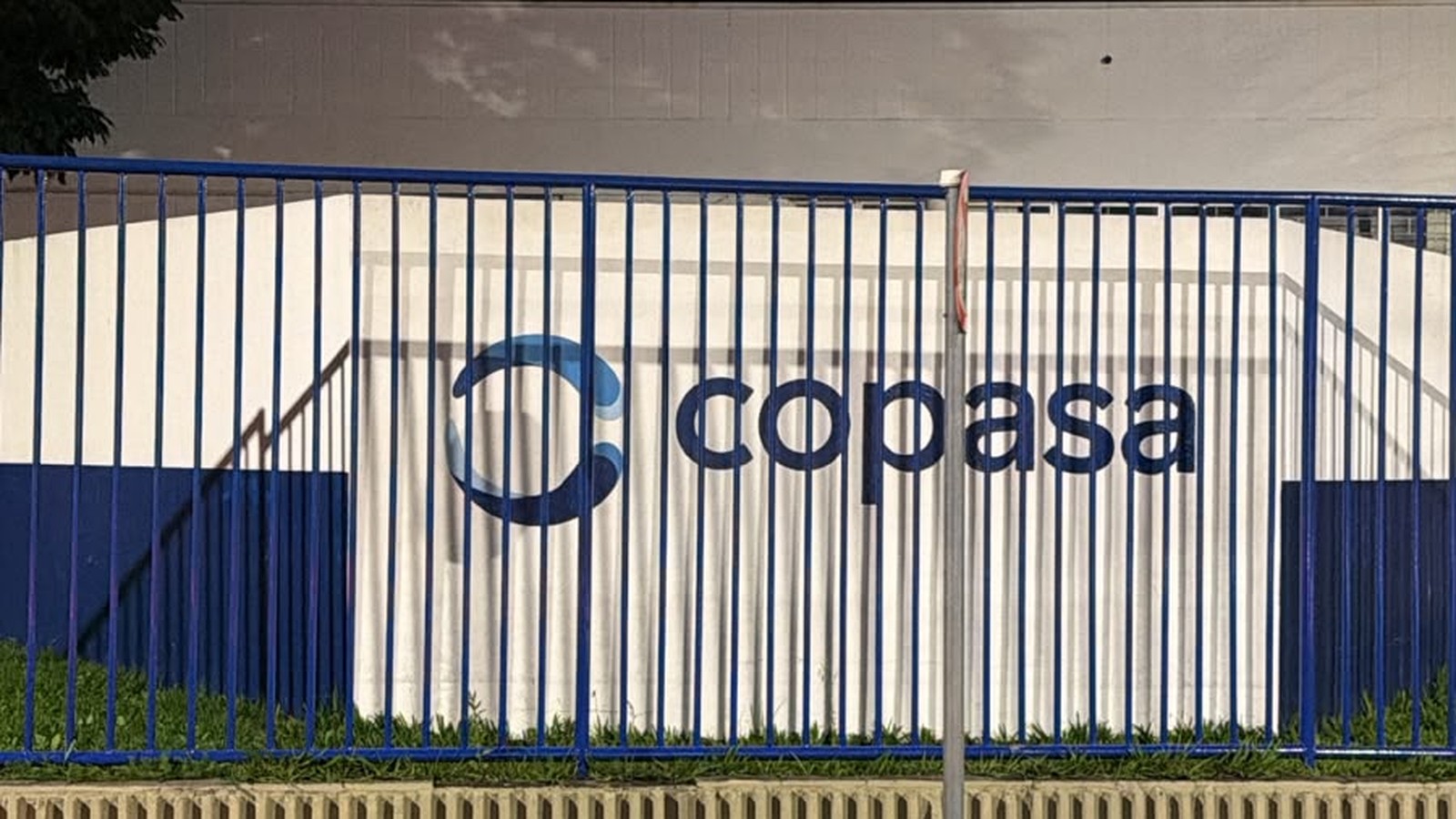
BREAKING NEWS · Rádio Cultura de Lavras
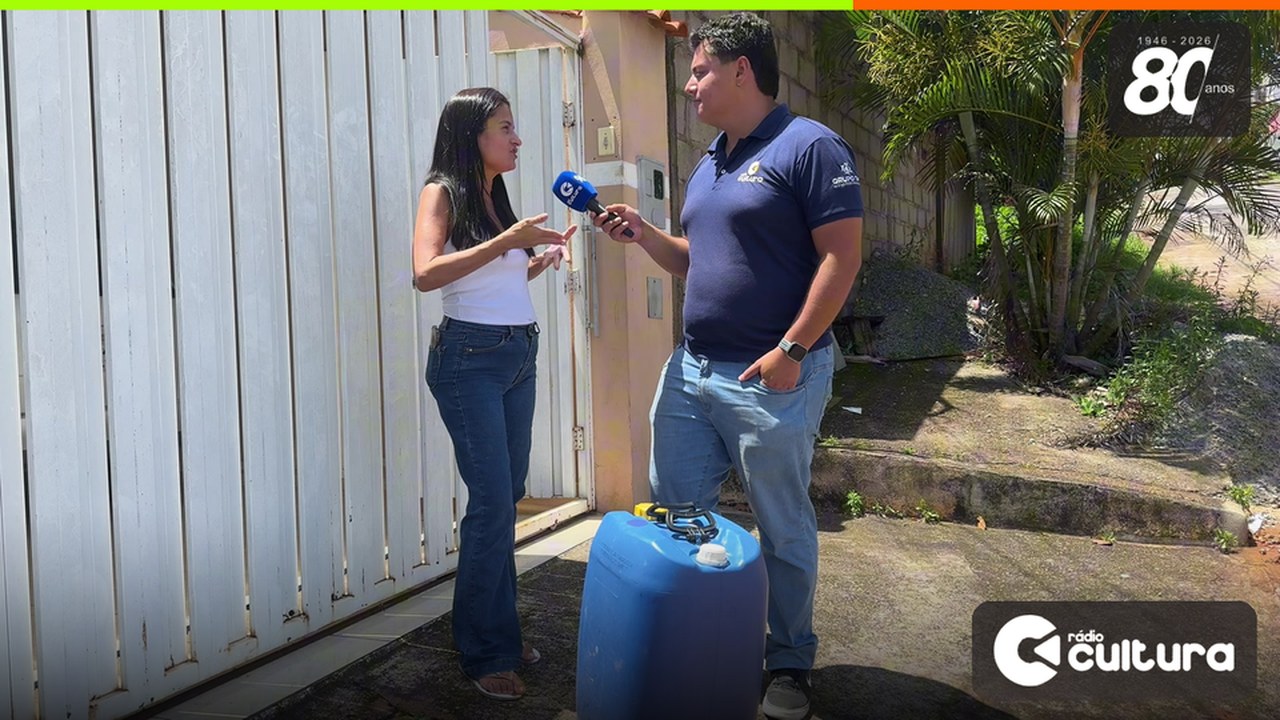
Picture a resident of Novo Água Limpa who, in October, went almost three days without a drop from the tap, with a nine-month-old baby at home and the plastic jug bought during the 2024 water shortage back in use. For her, Friday's news comes down to three words: bye, Copasa.
The Official Gazette of the Municipality of Lavras (Diário Oficial do Município de Lavras) published on Friday, November 13, 2026, in edition 3874, the result of the tender that selects the city's new water and sewage company. The winner is the Lavras Saneamento Consortium. Under the bid notice, after the contract is signed, the switch goes through a transition period of up to 90 days, after which the new company takes over the service from Copasa.
What the Official Gazette published today
The decision is in the Second Judgment Minutes of the Qualification Phase (Segunda Ata de Julgamento da Fase de Habilitação) of Bidding Process No. 122/2026 (Processo Licitatório nº 122/2026), In-Person Tender No. 01/2026 (Concorrência Presencial nº 01/2026). The Municipal Procurement Commission (Comissão de Contratação), chaired by Wilson Rodrigues Ribeiro, met at 13h15 this Friday and unanimously decided: the consortium is qualified and is the winner of the tender.
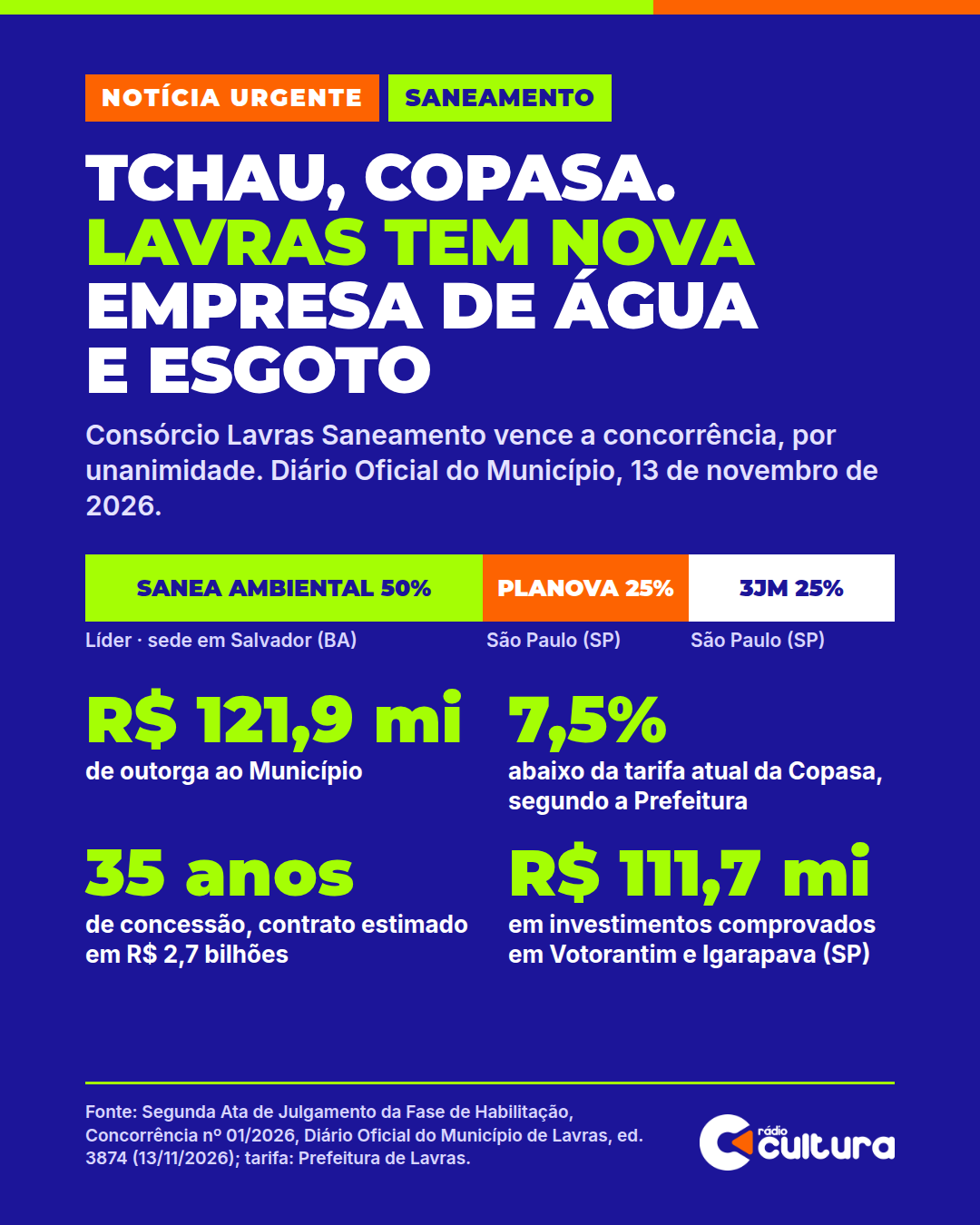
The proposal, opened at the session on October 26, offers R$ 121.891.710,65 in concession fee to the Municipality and a flat discount of 2,5% on the reference tariff set in the bid notice. In practice, according to the City Hall, the new tariff will be 7,5% below what Copasa charges today. The consortium has also committed to create its own company, a special purpose entity called SPE, headquartered in Lavras, to run the concession. The bid notice requires this company to have a minimum capital of R$ 25 milhões.
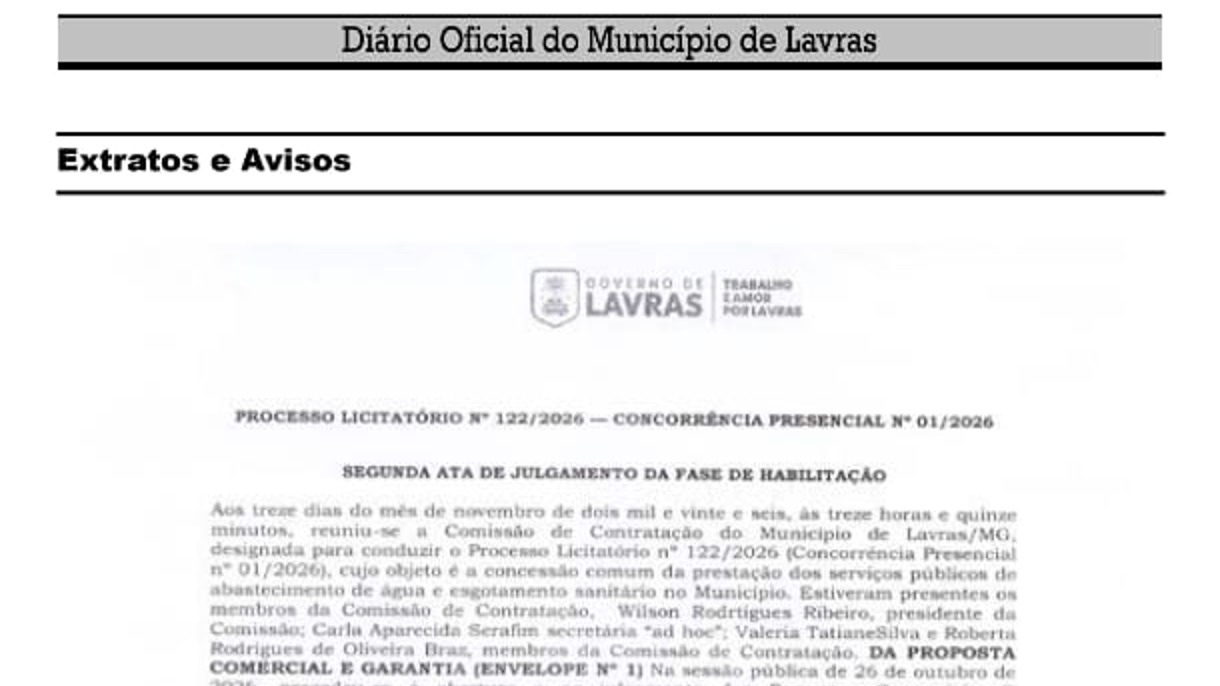
The minutes record that the consortium met all requirements: legal documents, federal, state, and municipal tax clearance certificates, Length-of-Service Guarantee Fund (FGTS) and labor clearance certificates, bankruptcy clearance certificates, a technical site visit conducted by the lead company, and the three required liquidity and debt ratios.
Who is the Lavras Saneamento Consortium
It is made up of three companies, with shares set out in the minutes:
- Sanea Ambiental Ltda., lead company, with 50%. According to the company's own website, it is headquartered in Salvador (BA) and is one of the three companies that operate Igarapava Saneamento, the water and sewage concession in Igarapava (SP), won at an auction on B3 in September 2023, with a 35-year contract.
- Planova Infraestrutura Ltda., with 25%. A company from São Paulo (SP). According to the regional press, it has already carried out infrastructure work for Copasa itself in Lavras, in 2010.
- 3JM Construtora e Incorporadora Ltda., with 25%. A construction firm headquartered in downtown São Paulo (SP), founded in 2007, according to the CNPJ registry.
To prove it can operate water and sewage services, the consortium presented its experience running the systems in Votorantim (SP) and Igarapava (SP), combined through companies under Sanea's common control, as the bid notice allows. The figures checked by the Technical Engineering Commission (Comissão Técnica de Engenharia):
- 34.861 residents served with water, when the bid notice required 30 mil;
- 34.692 residents served with sewage, against a minimum of 30 mil;
- 15.746 billing units (economias) of water and 15.019 of sewage, against a minimum of 15 mil each;
- R$ 111,7 milhões in proven investments (R$ 77,5 milhões in Votorantim and R$ 34,2 milhões in Igarapava), double the R$ 55,3 milhões required.
Long-term financing was also proven: a contract with BNDES, with a 21-month grace period and 96 installments, and a certificate from BTG Pactual regarding the issuance of debentures for the Igarapava concession.
Copasa's history in Lavras
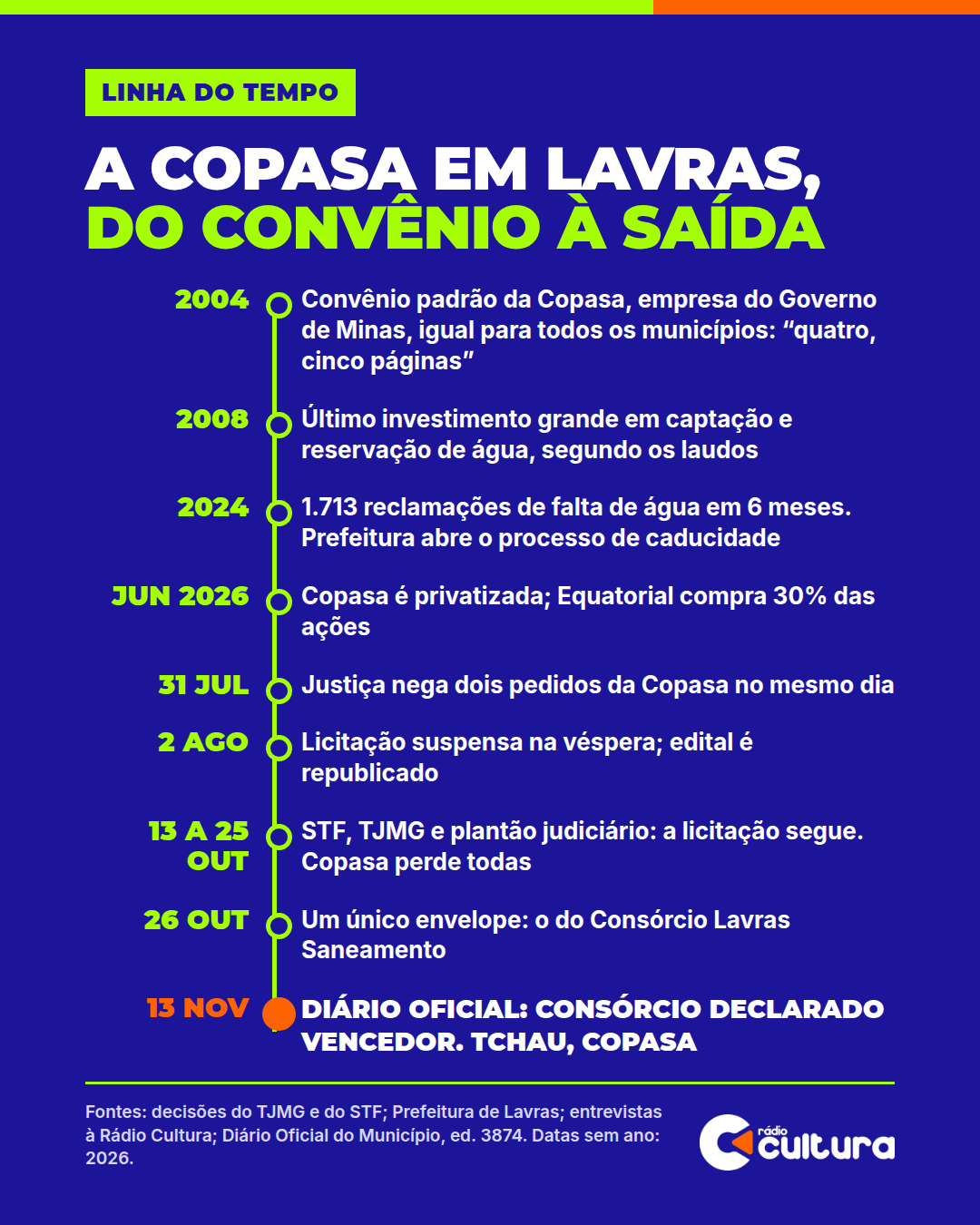
Copasa has operated Lavras' water and sewage under a 2004 agreement, according to the Municipal Environment Secretary (Secretário Municipal de Meio Ambiente), Adriano Garcia. A document he himself summed up this way, in an interview with Rádio Cultura: "a four- or five-page agreement".
That was the model at the time. Back then, the short agreement was the standard form that Copasa, a company owned by the State of Minas Gerais, brought ready-made to every municipality it served, backed by the State and leaving city halls very little room to negotiate clauses, targets, or investments. It was not a choice made by the municipal administration of that period: it was take Copasa's contract or go without the service. Only now, with the new sanitation framework and an open tender, has Lavras been able to write its own rules.
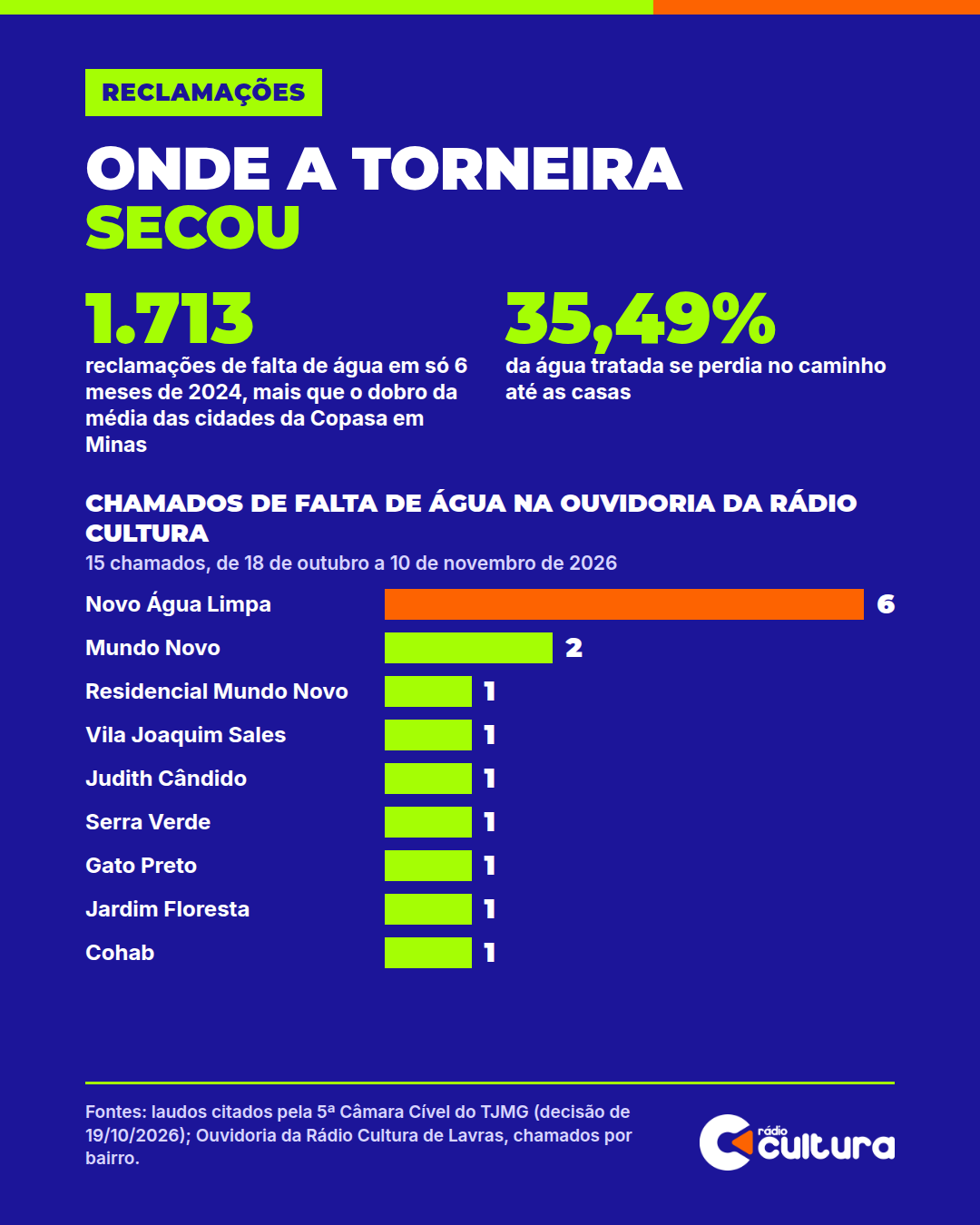
The expert reports used by the courts tell the rest. No major investment in water intake and storage since 2008. 35,49% of the treated water lost on the way to homes. And 1.713 complaints of water shortages in just six months of 2024, more than twice the average of the other cities served by Copasa in Minas Gerais. There were supply outages that even led to classes being suspended at schools.
In 2024, the City Hall opened an administrative forfeiture proceeding (processo administrativo de caducidade), the act that ends a contract due to failure to deliver the service. Forfeiture was declared, and since then Copasa has continued operating on an extraordinary and temporary basis until the switch. In June 2026, the company itself was privatized, with Equatorial buying 30% of its shares.
The court battle
- July 31: Judge Dr. Rodrigo Melo Oliveira of the 1st Civil Court of Lavras (1ª Vara Cível de Lavras) and the 5th Civil Chamber of the TJMG (5ª Câmara Cível do TJMG) deny two Copasa requests on the same day.
- August 2: new court rulings suspend the opening of the envelopes, scheduled for the following day. The bid notice is republished.
- October 13: at the Federal Supreme Court (Supremo Tribunal Federal), Minister Luiz Fux orders the TJMG to re-examine the compensation rule, but writes that the tender goes on.
- October 19: the TJMG upholds the forfeiture and clears the tender. The compensation will come from the concession fee paid by the winner, into a compensation account (Conta Indenização) created by the bid notice, and not from the City Hall's cash.
- October 23: Fux dismisses a second complaint by Copasa, which repeated the first.
- October 25: Judge Dr. Patrícia Narciso Alvarenga, on duty for the TJMG, denies the injunction Copasa sought to stop the submission of proposals.
- October 26: a single envelope reaches the City Hall, from the Lavras Saneamento Consortium. Copasa does not bid.
According to Luiz André, legal adviser to the City Hall's office, during the tender week alone Copasa filed at least 15 motions in court, and the Municipality won all of them. "Copasa, really, just wouldn't let go of the bone," he told Rádio Cultura.
Complaints from those who turn on the tap
Rádio Cultura's Ombudsman Office logged 15 calls about water shortages between October 18 and November 10, 2026. The neighborhood with the most calls was Novo Água Limpa, with 6, followed by Mundo Novo, with 2. There were also calls from Residencial Mundo Novo, Vila Joaquim Sales, Judith Cândido, Serra Verde, Gato Preto, Jardim Floresta, and Cohab.
The reports keep repeating: water that vanishes without warning, water that comes back dirty and orange, calls to 115 that drop, and complaint protocols that resolve nothing. "We call Copasa, they say it'll be back to normal, but nothing happens," said a resident of Jardim Campestre II, after three days without water.
The portal has recorded, in recent weeks alone:
- Water shortages in Novo Água Limpa, Mundo Novo, Vila Joaquim Sales, Jardim Campestre II, Alto dos Ipês and Gato Preto, between October 18 and 21, after a pumping failure; in Jardim Floresta, at the end of October; and in the Centro and Jardim das Acácias, on November 8.
- Dirty water, orange in color, in Serra Verde and Residencial Mundo Novo, for more than a week.
- Sewage overflowing with every rain in Jardim São Carlos, where a hole left by Copasa construction work became a garbage dump, and open sewage in Judith Cândido.
- Patched streets downtown, with poorly sealed trenches that sink weeks later, such as on Rua Misseno de Pádua and Rua Francisco Sales.
What changes for residents
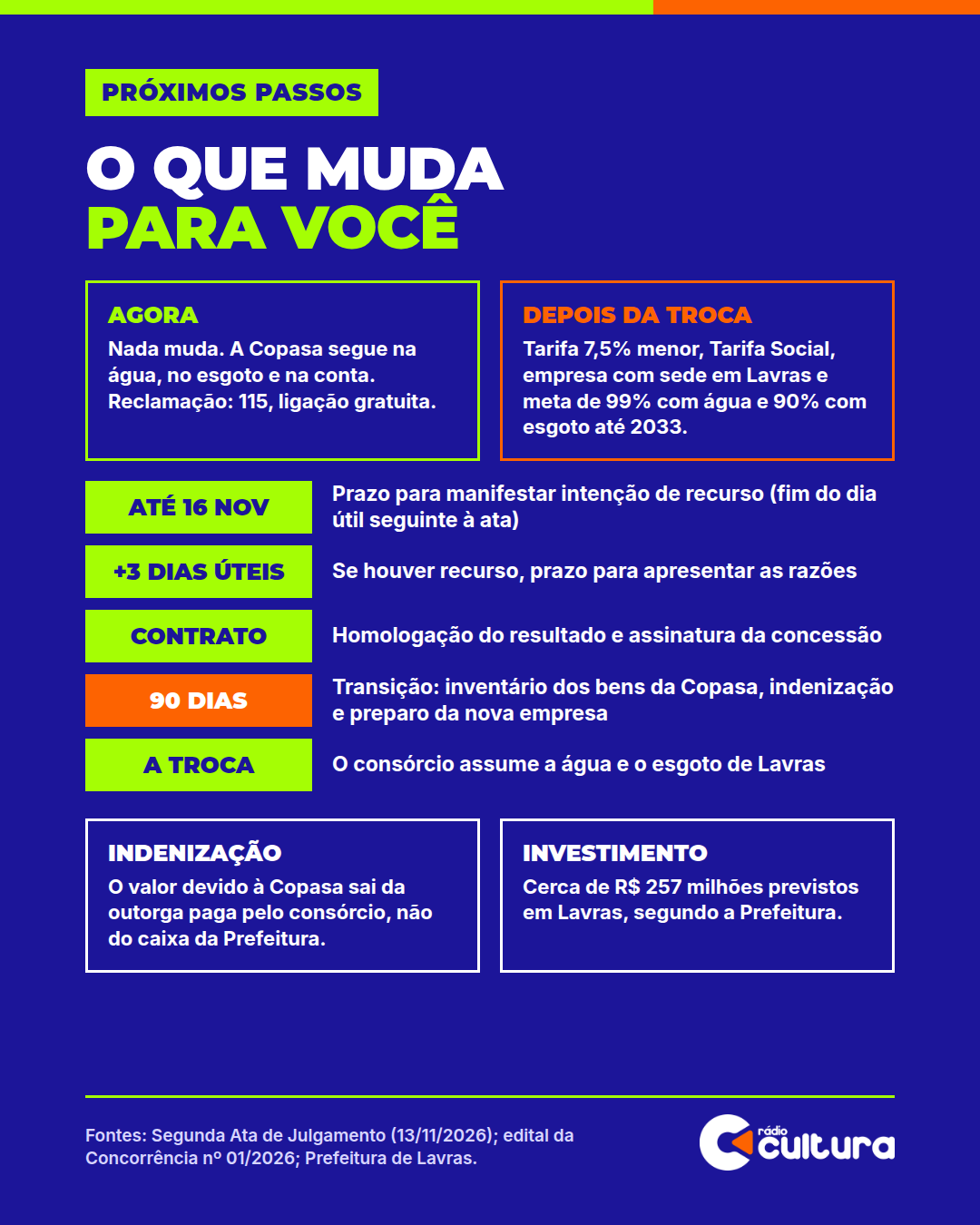
For now, nothing. Copasa remains responsible for water and sewage until the end of the transition. The bill keeps coming from Copasa, and complaints are still made through 115, a toll-free number, or at copasa.com.br. If it isn't resolved, the next step is Arsae-MG, at 0800 031 9293.
After the switch, operations pass to the consortium's company, headquartered in Lavras. Under the concession design:
- the tariff will be 7,5% below Copasa's current rate, according to the City Hall;
- there is a Social Tariff for low-income families;
- about R$ 257 milhões in investments in Lavras are planned, according to the City Hall;
- the legal target is to serve 99% of the population with water and 90% with sewage collection and treatment by 2033;
- oversight will be carried out by a regulatory agency chosen by the city itself, rather than by the State, and by an Independent Verifier.
The compensation Copasa is claiming for investments not yet recovered will come from the concession fee paid by the consortium, and the amount will be determined during the transition, in an audit involving Copasa, the City Hall, and the new company.
Next steps
- Appeal: anyone who wants to appeal must state their intention by the end of the business day after the minutes are published, that is, by the end of Monday, November 16. If an appeal is filed, a period of 3 business days opens for submitting the grounds.
- Contract: without an appeal, or once any appeals are decided, comes the ratification of the result and the signing of the concession contract.
- Transition: from the signing, there are up to 90 days to inventory Copasa's assets, settle the compensation, and prepare the new company.
- Switch: once the transition is complete, the Lavras Saneamento Consortium takes over the city's water and sewage services.
It's happening
Rádio Cultura congratulates Municipal Environment Secretary Adriano Garcia, who led the switch process, and Mayor Jussara Menicucci, for the decision to change the history of sanitation in Lavras. There were years of dry taps, patched streets, and sewage at the door. There were months of legal battles, from Lavras all the way to Brasília.
Now, the result is published. It's happening. Bye, Copasa.
The new company should begin operating within 90 days. It is published in the Official Gazette.
Sources: Second Judgment Minutes of the Qualification Phase, Bidding Process No. 122/2026, Official Gazette of the Municipality of Lavras, edition 3874, dated November 13, 2026; rulings of the TJMG and the STF (Complaints 100.091 and 101.513); interviews with Secretary Adriano Garcia and legal adviser Luiz André with Rádio Cultura; Rádio Cultura Ombudsman Office; Sanea Ambiental website; B3 auction of Igarapava (SP); CNPJ registry; O Fator and Diário do Comércio. Cover photo: Copasa branch in Lavras · Photo: Erlandson Araujo/Rádio Cultura.
0001311 · 01131126